2025-08-06

Station and QSL Manager non-respondents to direct QSL requests

Several QSL managers, and a handful of non-manager stations, operate "online QSL request systems" that allow one to pay for a direct QSL via Paypal. This assures the requester of the QSL that the money has correctly been received by the intended recipient (unlike, for example, when physical money is sent via the international postal system). For the most part, these OQRS exchanges work well. Unfortunately, though, I have found there to be a small number of cases in which the funds, although correctly transferred, have not resulted in the arrival of the corresponding QSL.

Below is a table showing my experience with stations that received the required funds for a direct QSL, as confirmed by a receipt from Paypal, but for which the corresponding card was never received by me. Note that this does not include requests that were sent via the Clublog OQRS, which are the subject of a separate post. The table lists requests made through the end of 2024, and for which the requested card has not been received as of early August, 2025.


Year of Request


Callsign


QSL Manager, if any


2019


Z31NA


2023

TL8AA

I2YSB

2024

TJ2TT

I2YSB

2024

HI3CC

EB7DX

2024

HI3AA

EB7DX

2024

HI3Y

EB7DX

2024

HI0LT

EB7DX

2025-08-05

Clublog OQRS non-respondents to direct QSL requests

This post updates an earlier post.

Clublog offers a service, known as OQRS (for "online QSL request service"), whereby one can send a direct request for a QSL to those stations that are willing to accept such requests. As part of the process of sending the request, Clublog automatically connects to Paypal so that the requester can pay the fee that the recipient of the request demands. This can be very useful: it makes requesting, and paying for, direct requests relatively quick and easy.

However, a very few people offering direct QSLs appear to take advantage of the system to collect the money from Paypal without sending the requested QSL.

Generally speaking, when someone whose QSL I desire does not respond to such a request within six months, I will send a polite follow-up e-mail, giving details of the QSO(s), the amount paid and the transaction ID of the Paypal transaction that transferred the money. If I hear nothing after a further three months, I repeat this exercise, but send this last e-mail from a different account, in case the account from which the first e-mail was sent is, for some reason, blocked by the recipient or some intermediate party.

After all this, there is a handful of stations who, in my direct experience, have neither sent the requested (and paid-for) QSL, nor responded to any of the e-mails.

These are the stations that, by my direct experience, have failed to fulfil the obligation to send a responsive QSL (with dates of the request up to the end of 2024):

Year of request          Call

2020                     D3AM
2021                     7X3IOTA
2021                     HC90IARU
2021                     PY0F/PP1CZ*
2021                     5X8C**
2021                     PY0FW
2022                     OH0T
2022                     TI9/3Z9DX***,†
2023                     CT3MD
2024                     EA7KW
2024                     OF9X
2024                     EA7X
2024                     CT8/S51TA
2024                     9X5RU‡

2024                     3D2CR†
2024                     3D2CCC†

* The Paypal payment was reversed by the recipient a couple of months after payment was made. No explanation was forthcoming from the recipient of the money (despite my questioning him via e-mail), and no QSL was ever received.

** A discussion did take place via e-mail, and it was agreed that the QSOs in question had indeed taken place, but there was some doubt as to who was responsible for sending out the requested card. Despite assurances that the issue would be dealt with, no card was ever received.

*** I did receive a responsive e-mail to this request, stating that the QSL would be sent at some future (unspecified) date; as of August, 2025, however, it has not yet been received. Were it to arrive, I should gladly remove the relevant call from the above list.

† I note that these entries all seem to be the responsibility of k38dom@gmail.com; sadly, I have never received any QSL in response to any money sent to that address. I continue to hope that that will change, and would be glad to hear from anyone who has had a more positive experience after sending a Clublog OQRS direct request to one of these calls. It would be marvellous were I to receive the requested cards and so be able to remove these calls from the above list.

‡ In April, 2025, I received an e-mail saying that a QSL had been sent to me in September, 2024. Unfortunately, no QSL was received. In response to my query, a second QSL was mailed to me (in April, 2025); but as of August, 2025, neither QSL had been received. I hope that this situation might change by the time I make the next update here.

I wish to emphasise that the great majority of stations faithfully respond to direct Clublog OQRS requests in a timely manner, and I thank such stations for offering this easy way to obtain their QSLs. This post is made merely so that those experiencing the disappointment of requests that have gone unanswered may see the stations that have likewise disappointed me.


2025-08-02

State-by-State Activity in ARRL DX SSB, 2025

Earlier posts in this series:


Using the public logs from ARRL DX SSB 2025, we can generate the following band-by-band activity maps for the continental U. S.


State-by-State Activity in ARRL DX CW, 2025

Earlier posts in this series:


Using the public logs from ARRL DX CW 2025, we can generate the following band-by-band activity maps for the continental U. S.


Cleaned and Augmented Logs for ARRL DX CW and SSB contests, 2018 to 2025

Cleaned Logs


Cleaned logs for the years 2018 to 2025 may be downloaded from this directory. The cleaned logs are combined into a single file; but data for individual stations and years may be extracted trivially from the combined file.

The cleaned logs are the result of processing the QSO: lines from the entrants' submitted Cabrillo files (as [gratuitously] modified by the ARRL) to ensure that all fields contain valid values and all the data match the column-specific standard format for this contest.

Any line containing illegal data in a field has simply been removed. Also, only the QSO: lines are retained, so that each line in the file can be processed easily. All QTH multipliers are rendered as two letters, and the power is rendered as four digits, regardless of how the submitted log recorded these two fields; this should simplify processing the logs by scripts or programs, as should the use of fixed-length records in these cleaned files.

Augmented Logs


Links to augmented logs for the same years may likewise be downloaded from the same directory. The augmented logs are combined into a single file; but data for individual stations and years may be extracted trivially from the combined file.

The augmented logs for the ARRL DX contests contain the same information as the cleaned logs, but with the addition of some useful (derived) information on each line. The information added to each line comprises:
  1. The sequence of four characters that are the same for each entry in a particular log:
    •  a. letter "A" or "U" indicating "assisted" or "unassisted"
    •  b. letter "Q", "L", "H" or "U", indicating respectively QRP, low power, high power or unknown power level
    •  c. letter "S", "M", "C" or "U", indicating respectively a single-operator, multi-operator, checklog or unknown operator category 
    •  d. character "1", "2", "+" or "U", indicating respectively that the number of transmitters is one, two, unlimited or unknown
  2. A four-digit number representing the time if the contact in minutes measured from the start of the contest. (I realise that this can be calculated from the other information on the line, but it saves subsequent processors of the file considerable time to have the number readily available in the file without having to calculate it each time.)
  3. Band
  4. A set of fourteen flags, each -- apart from column k and column n -- encoded as T/F: 
    • a. QSO is confirmed by a log from the second party 
    • b. QSO is a reverse bust (i.e., the second party appears to have bust the call of the first party) 
    • c. QSO is an ordinary bust (i.e., the first party appears to have bust the call of the second party) 
    • d. the call of the second party is unique 
    • e. QSO appears to be a NIL 
    • f. QSO is with a station that did not send in a log, but who did make 20 or more QSOs in the contest 
    • g. QSO appears to be a country mult (may be T for W/VE stations only)
    • h. QSO appears to be a state/province mult (may be T for DX stations only)
    • i. QSO is an exchange bust (i.e., the received exchange appears to be a bust)
    • j. QSO is a reverse exchange bust (i.e. the second party appears to have bust the exchange of the first party)
    • k. This entry has three possible values rather than just T/F:
      • T: QSO appears to be made during a run by the first party
      • F: QSO appears not to be made during a run by the first party
      • U: the run status is unknown because insufficient frequency information is available in the first party's log
    • l. QSO is a dupe
    • m. QSO is a dupe in the second party's log
    • n. RBN information (see below)
  5. If the QSO is a reverse bust, the call logged by the second party; otherwise, the placeholder "-"
  6. If the QSO is an ordinary bust, the correct call that should have been logged by the first party; otherwise, the placeholder "-"
  7. If the QSO is a reverse exchange bust, the exchange logged by the second party; otherwise, the placeholder "-"
  8.  If the QSO is an ordinary exchange bust, the correct exchange that should have been logged by the first party; otherwise, the placeholder "-"

RBN Information


In CW contests from 2009 onwards, the RBN has been active, automatically spotting the frequency at which any station calling CQ was transmitting. To reflect possible use of RBN information, the augmented files include a fourteenth column. For the sake of uniformity, this column is present in all the augmented files, regardless of whether the RBN actually contributed useful information to a particular contest.

Each QSO has one of several characters in the fourteenth column of flags. These characters should be interpreted as follows:

'-'
  No useful RBN-derived information is available for this QSO.

'0'
  The worked station (i.e., the second call on the log line) appears to have begun to CQ on this frequency within (roughly) 60 seconds prior to the QSO.

'A' to 'Z'
  For the nth letter of the alphabet: the worked station appears to have been CQing on this frequency for (roughly) n minutes prior to the QSO.

'+'
  The worked station appears to have been CQing for more than 26 minutes on this frequency.

'<'
  Because the the RBN is distributed, and because each contest entrant station has its own clock, there is generally a skew between the reading of the clock of the station making the QSO and the timestamp from the RBN at which it believes a posting was made (indeed, it's unclear from the RBN's [lack of] documentation exactly how the timestamp on an individual RBN posting is to be interpreted). If the character '<' appears in the the RBN column, it indicates that the raw values of the clocks suggest that the QSO took place up to two minutes before the RBN reported the worked station commencing to CQ at this frequency. When this occurs, the most likely interpretation is that there is non-negligible skew between the two clocks, and the station was actually worked almost as soon as a CQ was posted by the RBN. But it might also mean that the entrant was simply lucky and found the CQing station just as it fired up on a new frequency.

Notes:
  • The encoding of some of the flags requires subjective decisions to be made as to whether the flag should be true or false; consequently, and because the ARRL has yet to understand the importance of making the scoring code public, the value of a flag for a specific QSO line in some circumstances might not match the value that the ARRL has assigned. (Also, the ARRL has additional, non-public, data available.)
  • I made no attempt to deduce or infer the run status of a QSO in the second party's log (if such exists), regardless of the status in the first party's log. This allows one cleanly to perform correct statistical analyses anent the number of QSOs made by running stations merely by excluding QSOs marked with a U in column k.
  • No attempt is made to detect the case in which both participants of a QSO bust the other station's call. This is a problematic situation because of the relatively high probability of a false positive unless both stations log the frequency as opposed to the band. (Also, on bands on which split-frequency QSOs are common, the absence of both transmit and receive frequency is a problem.) Because of the likelihood of false positives, it seems better, given the presumed rarity of double-bust QSOs, that no attempt be made to mark them.
  • The entries for the exchanges in the case of exchange or reverse exchange busts are normalised to two-letter or four-digit values in the same manner as described above for the exchanges in the cleaned logs.


2025-05-12

Continent-Based Analyses from 2024 CQ WW SSB and CQ WW CW logs

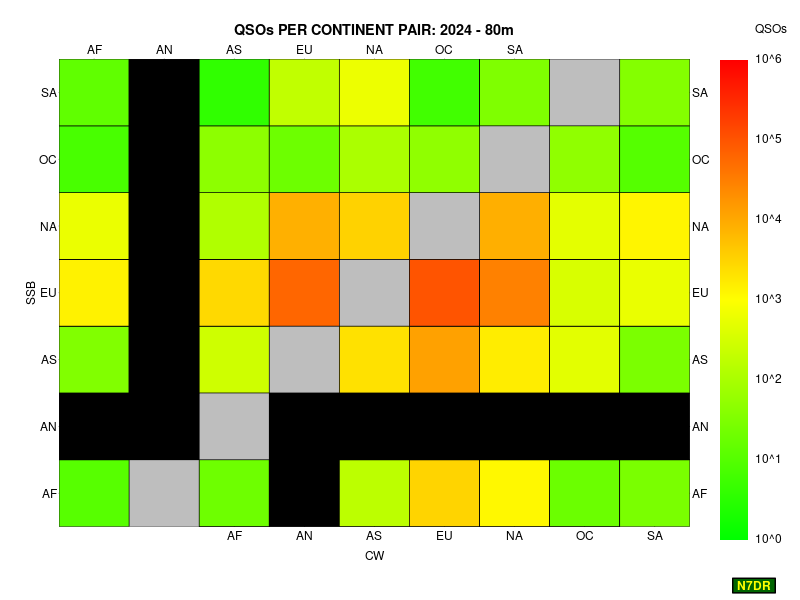
In addition to zone-based analyses, we can perform similar analyses based on continent rather than zone using the public CQ WW logs (see here for details of the augmented format) for the period from 2005 to 2024.

Continent Pairs


We start by looking at the number of QSOs for pairs of continents from the contests for 2024.

The procedure is simple. We consider only QSOs that meet the following criteria:
  1. marked as "two-way" QSOs (i.e., both parties submitted a log containing the QSO);
  2. no callsign or zone is bust by either party.

A counter is maintained for every possible pair of continents and the pertinent counter is incremented once for each distinct QSO between stations in those continents.

Separate figures are provided below for each band, led by a figure integrating QSOs on all bands. The figures are constructed in such a way as to show the results for both the SSB and CW contests on a single figure. (Any pair of continents with no QSOs that meet the above criteria appears in black on the figures.) Note the logarithmic scale.


Continents and Distance


Below is a series of figures showing the distribution of distance for QSOs as a function of continent.

Each plot shows a colour-coded distribution of the distance of QSOs for each continent, with the data for SSB appearing above the data for CW within each continent.

For every half-QSO in a given continent, the distance of the QSO is calculated; in this way, the total  number of half-QSOs in bins of width 500 km is accumulated. Once all the QSOs for a particular mode have been binned in this manner, the distribution for each continent is normalised to total 100% and the result coded by colour and plotted. The mean distance for each continent and mode is denoted by a small white rectangle added to the underlying distance distribution. The 99% confidence range of the value of mean is marked by a small blue rectangle (typically entirely subsumed by the white rectangle). The median is marked with a vertical brown rectangle.

As usual, only QSOs for which logs have been provided by both parties, and which show no bust of either callsign or zone number are included. Bins coloured black are those for which no QSOs are present at the relevant distance.

The resulting plots are reproduced below. The difference between EU and the other continents is stark.


Half-QSOs Per Continent, 2005 to 2024


A simple way to display the activity in the CQ WW contests is to count the number of half-QSOs in each continent (a single QSO contains two half-QSOs, so a single QSO may contain two different continents or the same continent twice). We count half QSOs, making sure to include each valid QSO only once (that is, if the same QSO appears in two submitted logs, it is counted only once).

If we do this for the entire contest without taking the individual bands into account, we obtain this figure:


The plot shows data for both SSB and CW contests over the period from 2005 to 2024. I include only QSOs for which both parties submitted a log and neither party bust either the zone or the call of the other party. The black rectangles represent contests in which no half-QSOs were made from (or to) a particular continent. Perhaps more than any other plot, this makes unmistakable the dominance of EU in the CQ WW contests.

We can, of course, generate equivalent plots on a band-by-band basis:


As in prior years, the activity from EU so overwhelms these figures that in order to get a feel for the activity elsewhere, we need to move to a logarithmic scale:


Intra-Continental QSOs


We can also easily look at the percentage of QSOs that are between two stations on the same continent, and in particular between two EU stations:


So, for example, in CQ WW SSB in 2024, close to a quarter of all QSOs were within the same continent; nearly a fifth of all QSOs in the contest were between two European stations. 


Flogging a dead horse as I do every year, on 160m 60% of QSOs in this "world wide DX" contest were between two European entrants, even in the more DX-friendly mode. On SSB, about four fifths of all QSOs were between two European entrants.

Intra-EU QSOs

Mostly because I wondered about the effect of the Russian invasion of Ukraine, I've been taking a look at the percentage of QSOs (half-QSOs, really) with the different EU countries over time.

I continue find the results interesting, not only for clarification of the above issue, but also in regard to the changing activity from different countries between CW and SSB, and over time: